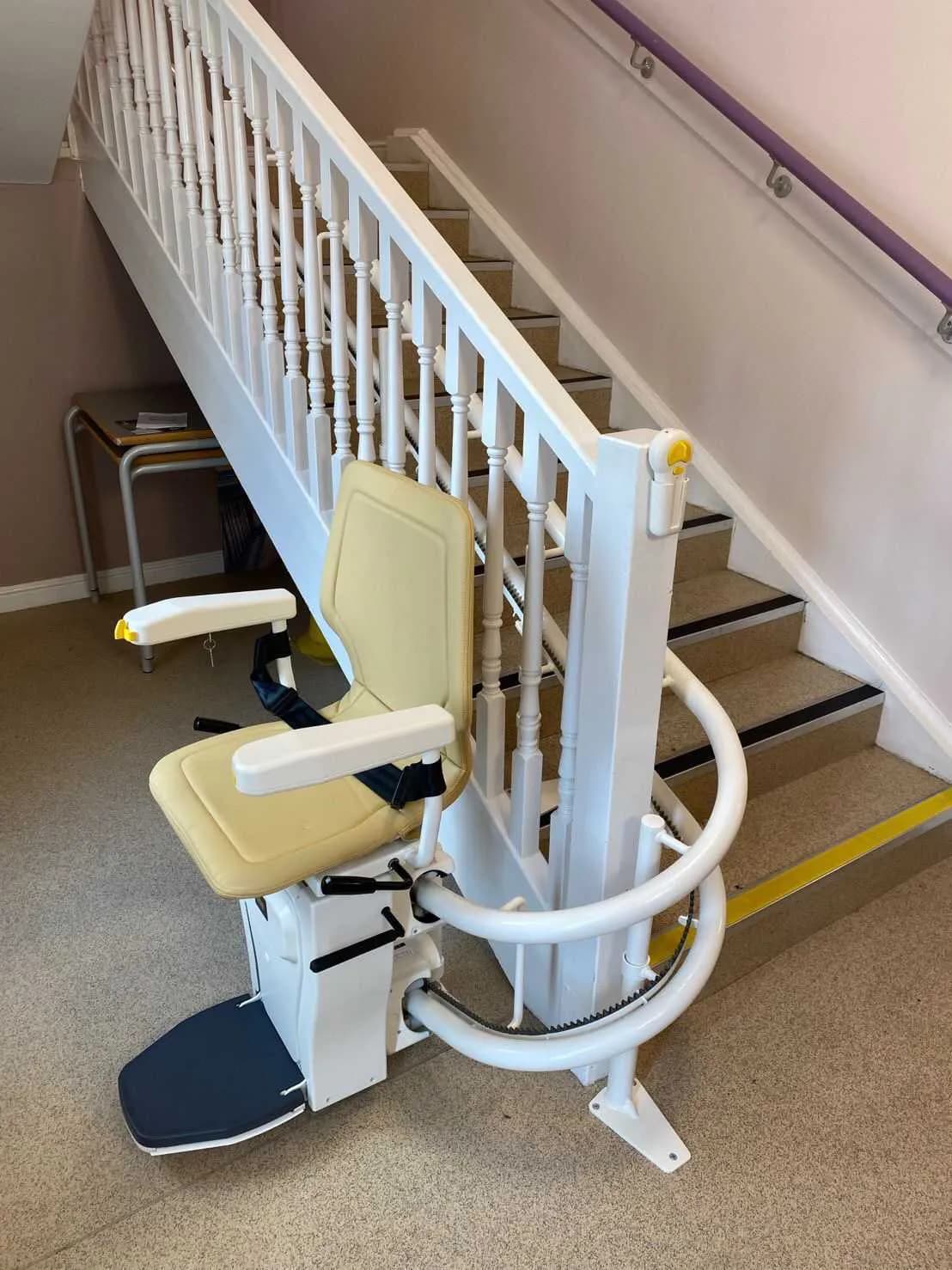
A Rail Bent to Your Exact Staircase.
If your stairs turn, split around a landing, or fan out on winder steps, a straight rail will not fit. A curved stairlift is manufactured from measurements of your staircase and nobody else's.
One turn is enough. So is one landing.
Stand at the bottom of your stairs and look up. If the staircase bends out of view — around a corner, over a mid-flight landing, or through a fan of triangular winder steps — a straight rail cannot follow it.
The honest version of the trade-off: a curved stairlift costs roughly three times a straight one, because the rail is a made-to-order steel component, not a length cut from stock. What you get for that is a lift that follows your staircase continuously, so you ride from the bottom floor to the top without getting off and transferring at a landing.
You need a curved rail if
- The staircase turns 90° or 180° at any point
- There is a landing partway up, with steps continuing after it
- Winder steps fan around a corner instead of a flat landing
- The stairs run straight but you need to overrun past the top step onto the landing
- The bottom of the stairs curves out into the hallway or foyer
- A previous installer told you your staircase "won't work" for a stairlift
Recognize two or more? A free in-home assessment will tell you exactly what fits. No obligation.
What the custom rail buys you
One continuous ride
No transferring between two separate lifts at a landing. You get on at the bottom and off at the top, once.
Fits the staircase you have
The rail is bent to your measured angles and radii. It hugs the inside edge, keeping the walking width as generous as possible.
Overrun onto the landing
The rail can extend past the top step so the seat parks on flat floor. You step off onto the landing, never onto a stair.
Safe on the turn
The carriage stays level through every bend, and the drive slows automatically on tighter radii.
Still no wall work
Like a straight rail, it mounts to the treads. Curved does not mean structural.
Battery drive
Runs through a power cut and charges at both parking positions.
Your staircase is surveyed, then the rail is manufactured to match.
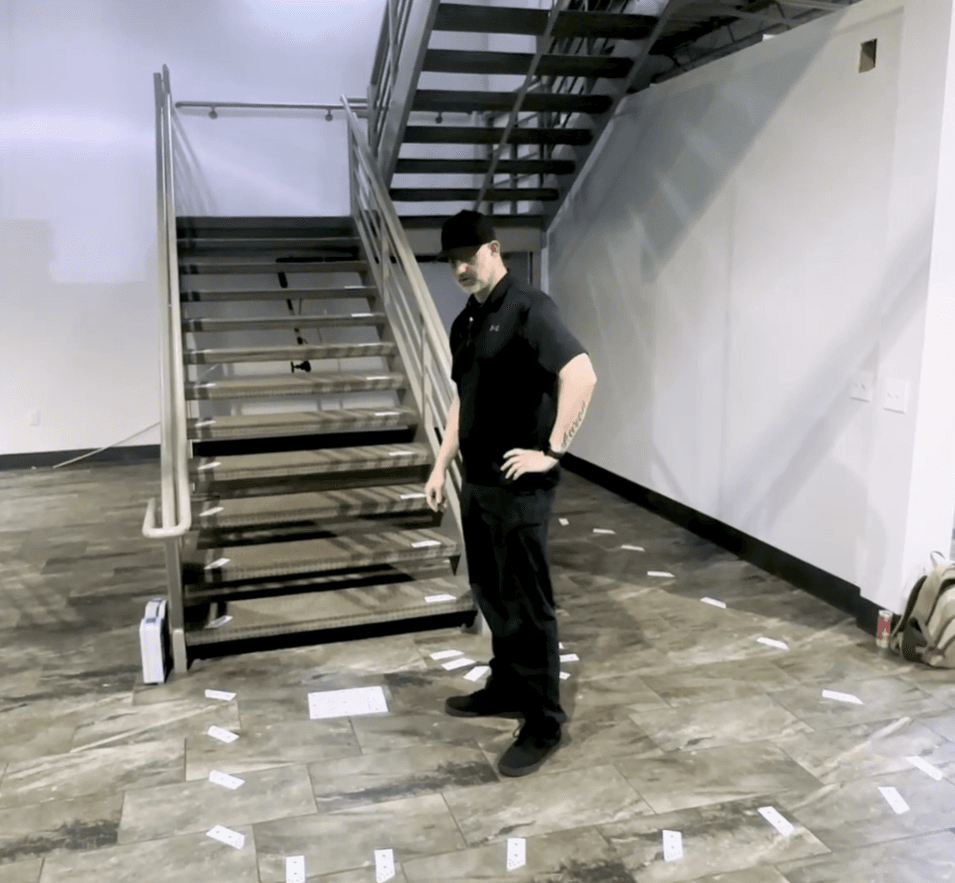
A curved stairlift starts with a measurement session in your home. We record the rise and run of every step, the angle and radius of each turn, the position of the newel posts, and where the rail needs to start and stop. On a modern survey this is done with a laser measuring tool that captures the geometry as a data set rather than a sketch.
That data goes to the manufacturer, where the rail is bent from steel tube to match your staircase, then test-assembled before it ships. This is why the lead time is weeks rather than days — and why the rail from your neighbor's house will not fit yours even if the staircases look identical.
- On-site laser survey — typically an hour, no commitment required
- Rail manufactured and trial-fitted before shipping
- Delivered in sections and joined on site to keep it through your front door
- Install is usually a half to full day, depending on the number of turns
- Inside rail: maximum remaining stair width, tighter turn radius
- Outside rail: smoother ride through the bend, more space taken
- Park-away curves at either end keep landings and doorways clear
- Powered swivel at the top landing for anyone who cannot twist to dismount
Inside rail or outside rail, and why it matters.
On a turning staircase the rail can run along the inside of the bend or the outside. Inside is the tighter, more compact route and usually preserves more walking width; outside gives a gentler curve and a more comfortable ride, but eats more of the staircase. On winder steps the choice is often made for you by where there is enough tread depth to bolt into.
The other decision is what happens at each end. A rail that stops at the bottom step is cheapest. A rail that curves out into the hallway, or parks around a corner out of the way of the front door, costs more and is frequently worth it in a narrow North Jersey entryway where the alternative is a stairlift parked in the middle of the traffic.
Two straight lifts and a transfer at the landing.
A cheaper approach some companies propose for a staircase with a landing is two straight stairlifts — one per flight — with the person getting off, walking across the landing, and getting onto the second lift.
It is genuinely less expensive, and for some households it is a reasonable compromise. But it also means standing and transferring unassisted on a landing partway up a staircase, which is precisely the situation most people bought a stairlift to avoid. We will quote it if you ask, and we will be direct with you about who it does and does not suit.
- Two lifts require two transfers per trip, in both directions
- The landing transfer happens without a handrail on at least one side
- Works best when the user walks confidently on the flat and only struggles with stairs
- A single curved rail removes the transfer entirely
Honest comparison for a turning staircase
| Feature | Curved stairlift | Two straight lifts | Home elevator |
|---|---|---|---|
| Relative cost | Higher | Lower | Highest by far |
| Transfers per trip | None | One, on the landing | None |
| Lead time | 2–4 weeks | Often within a week | 8–16 weeks |
| Construction work | None | None | Shaft, pit, permits, framing |
| Takes floor space | No | No | Yes — a room on every floor |
| Carries a wheelchair | No — seated transfer | No — seated transfer | Yes |
| Removable later | Yes | Yes | No, not practically |
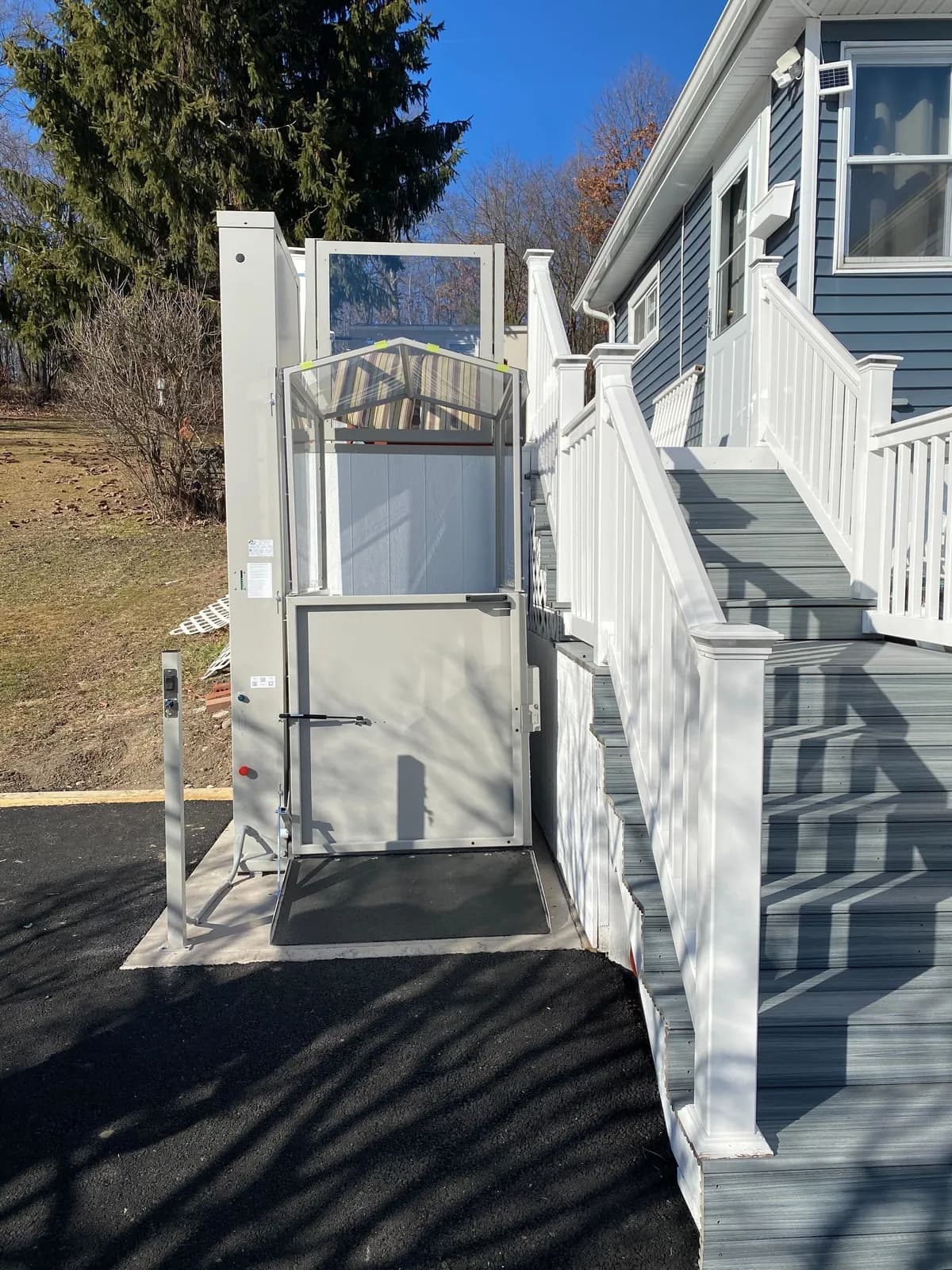
A curved stairlift carries a seated passenger, not a wheelchair. If the person cannot transfer out of their chair, a vertical platform lift or a home elevator is the right conversation.
From survey to first ride
Why curved costs what it does
The rail is a bespoke manufactured part, and that is the entire reason curved sits above straight. We do not publish figures — a single-turn staircase and a three-winder staircase are different jobs, and only the survey tells us which one you have. What we can do is be clear about what moves the number.
What moves the cost
Questions we get every week
Why is a curved stairlift so much more expensive than a straight one?
Because the rail is manufactured specifically for your staircase. A straight rail is cut from stock in minutes; a curved rail is bent from steel tube to your measured angles, trial-assembled at the factory, and shipped in sections. The chair and drive are broadly similar — the rail is where the money goes.
How long does a curved stairlift take to arrive?
Typically 2 to 4 weeks from survey to installation, because manufacturing starts only after your staircase is measured. If someone quotes you a curved rail available this week, ask what they are actually proposing.
Can I buy a used curved stairlift?
Only if the rail was built for a staircase geometrically identical to yours, which is rare enough not to plan around. Reconditioned curved lifts usually mean a reconditioned chair and drive on a new rail, and that can be a genuine saving — ask us and we will tell you what is actually available.
Will it fit around my winder steps?
Usually yes. Winders are one of the main reasons curved rails exist. The survey determines whether the rail runs inside or outside the fan and whether there is enough tread depth for the brackets.
Will it block the staircase for everyone else?
With the seat folded, the lift takes roughly 13 inches from one side. On a turn, the rail follows the inside edge where possible to preserve walking width. We will tell you at the survey exactly how much clear width you will be left with.
Does it damage the staircase?
No. The rail mounts to the stair treads with brackets, not to your wall or banister. Removal leaves small screw holes in the treads and nothing else.
Would two straight stairlifts be cheaper?
Yes, meaningfully — but it requires getting off at the landing and onto a second lift, twice per round trip. For someone who walks confidently on flat ground, that can be a fair trade. For someone whose balance is the reason they called, it is usually not.
Can the rail be moved to another house later?
The chair and drive can be reused. The rail cannot — it was bent for one staircase. Plan on the rail being specific to the home.
Explore other solutions
Ready to see what
this would cost?
Book a free in-home assessment. We measure, quote in writing, and leave the decision to you.